C-Spine Manual Stabilization
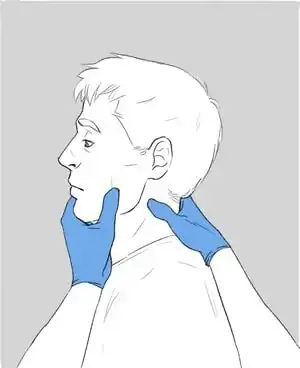
| Subskill of | Airway Breathing Circulation Head Trauma Penetrating Chest Trauma Primary Assessment Seated Spinal Immobilization (KED) Spinal Immobilization Adult Spinal Trauma Trauma Patient Assessment |
|---|---|
| Acting roles | EMR emergency medical responder EMT emergency medical technician paramedic |
| Pathologies | broken spine (potential) |
| Body systems | skeletal system nervous system |
| Body parts | head spine c-spine |
Manual C-spine immobilization is an important skill for any medical provider to master, and it is especially important in the prehospital environment due to the myriad of patient positionings and presentations that we as responders often come across. The basics of manual C-spine immobilization are the same regardless of patient position: the goal is to prevent movement of the cervical spine while keeping the patient as comfortable and calm as possible.
In this section, we will discuss several different methods of manual C-spine immobilization.
Supine patient - rescuer at the head
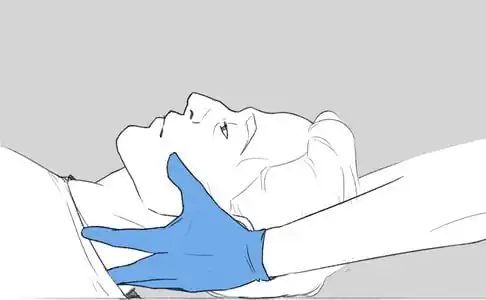
While kneeling or lying above the patient's head, the rescuer's hands should be placed on the side of the face/neck with thumbs extended to provide support to the side of the head. Fingers should be spread out to cover a greater surface area and be in contact with the bony areas of the jaw and skull. Avoid placing pressure on the soft tissues of the neck. If your hands are needed, your knees and thighs may be used as replacements for hands, if absolutely necessary.
Prone patient - rescuer at the head
Image.
C-spine management for a prone patient is similar to management of a supine patient, with one critical difference: the rescuer's hands should be flipped in a way that allows for normal stabilization of the C-spine when the patient is rolled over. It is inadvisable to attempt to hold C-spine while supine and roll over with the patient as the rescuer's elbows will frequently be caught on the ground while rolling and can lead to a loss of stabilization. While lying or kneeling above the patient's head, the rescuer's hand should be placed on the side of the face/neck with thumbs extended to provide support to the side of the head. Fingers should be spread out to cover a greater surface area and be in contact with the bony areas of the jaw and skull. Avoid placing pressure on the soft tissues of the neck.
Sitting patient - rescuer behind
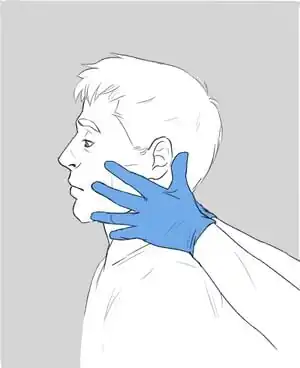
This scenario describes the typical patient who was a driver or passenger in a car accident where the rescuer is able to enter the second row of seats and hold c-spine from behind. The rescuer's hands can be placed with fingers are pointing upwards or anteriorly, spread out to cover a greater surface area and in contact with the bony areas of the jaw and skull. If the patient is in a car seat, the rescuer's arms may be extended; search for a position that you can hold for a significant amount of time if extrication is likely to take a long time. If the patient is sitting in a chair, the rescuer may stand behind the patient and hold c-spine the same way.
Sitting patient - rescuer in front
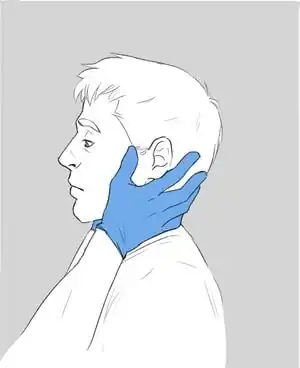
The rescuer in this scenario has decided to hold c-spine from the front of a sitting patient. This position allows for face-to-face conversation and may be useful for history gathering. The rescuer's hands can be placed with fingers pointing upwards or anteriorly, spread out to cover a greater surface area and in contact with the bony areas of the jaw and skull. This method of manual c-spine stabilization may expose the rescuer to increased risk from airborne and droplet borne pathogens.
Standing patient - rescuer to the side
In this scenario, the patient may be standing or sitting. The rescuer will approach from the side of the patient and place one hand on the back of the patient's head with the rescuer's arm supported against the patient's back. The rescuer's other arm will be resting on the patient's sternum while the rescuer's hand makes a "V" shape between the thumb and other fingers and securely holds the patient's chin. This method of manual c-spine immobilization allows for greater anterior-posterior stabilization while still allowing for conversation and history gathering.
| Authors | GSTC |
|---|---|
| License | CC-BY-SA-4.0 |
| Cite as | GSTC (2021–2025). "C-Spine Manual Stabilization". Appropedia. Retrieved November 28, 2025. |