Airway
Airway management is based on the PTC manual handbook, where the first priority is establishment or maintenance of an open airway.
Principles
Basic Anatomy
Assessment
Talk to the patient!
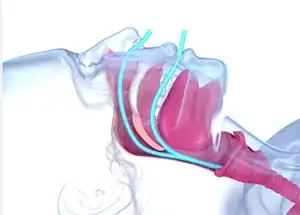
A patient who can speak clearly must have a clear airway. The unconscious patient may require airway and breathing assistance. The most common cause of airway obstruction in an unconscious patient is the tongue falling back to block the airway. If the patient can speak with a normal voice, then their airway is clear. If they can talk in full sentences, then their breathing is probably normal.
Positioning
Will be dependant on patient cognition and suscipicion of associated spinal injury.
Protect the cervical spine
Airway assessment and management must include care of the neck. If there is any suggestion of head or neck injury or suspicion from the mechanism of injury, then the cervical spine should be stabilised and protected.
Give Oxygen
Supplemental oxygen helps improve the effectiveness of patient breathing to provide adequate tissue perfusion. It can be administred via the airway as low (e.g. nasal cannula or face mask) or high pressure (e.g. endotracheal intubation or hyperbaric chamber) and can also bypass the airway (e.g. ECMO therapy).
Assess Airway[1]
(look, listen and feel)
The signs of airway obstruction may include:
- Snoring or gurgling
- Stridor (high pitched whistling sound) or abnormal breath sounds
- Wheezing (low moaning pitch typically heard on exhalation and is indicative of lower airway obstruction)
- Agitation (hypoxia)
- Using the accessory muscles of ventilation
- Presence of paradoxical chest movements
- Cyanosis
A completely obstructed airway is silent. Use a pulse oximeter, if one is available, to detect hypoxia.
Look for foreign bodies; the techniques used to establish an open airway are outlined in Appendices 2 and 4.
Management
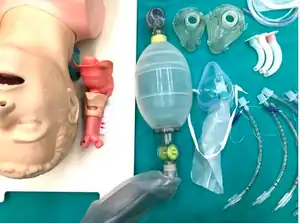
Basic airway management
- Remove foreign bodies
- Suction
- Basic airway opening techniques (jaw thrust or chin lift)
- Simple airway adjuncts[2] - Nasopharyngeal airway (NPA) or Oropharyngeal airway (OPA)
- Give Oxygen and consider assisted ventilation with Bag-Valve-Mask (BVM)
Consider the need for advanced airway management
Indications for advanced airway management techniques for securing the airway include:
- Apnoea - temporal cessation of spontaneous breathing
- Hypoxia[3] - inadequate oxygen delivery to tissues
- Persisting airway obstruction
- Severe head injury
- Maxillofacial injury
- Penetrating neck trauma with haematoma (expanding)
- Chest trauma
(Airway Management Techniques are discussed further in Appendix 2)
| Authors | William M Nabulyato |
|---|---|
| License | CC-BY-SA-4.0 |
| Cite as | William M Nabulyato (2022–2025). "PTC Course/Airway". Appropedia. Retrieved November 28, 2025. |