Waste Plastic Direct Extrusion Hangprinter
| Type | 3D Printing recycling |
|---|---|
| Authors | Aliaksei Petsiuk Bharath Lavu Rachel Dick and Joshua M. Pearce |
| Status | |
| Years | 2022 |
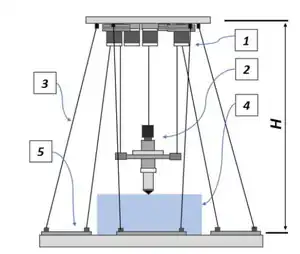
As the additive manufacturing industry grows, it is compounding the global plastic waste problem. Distributed recycling and additive manufacturing (DRAM) offers an economic solution to this challenge, but it has been relegated to either small-volume 3D printers (limiting waste recycling throughput) or expensive industrial machines (limiting accessibility and lateral scaling). To overcome these challenges, this paper provides proof-of-concept for a novel, open-source hybrid 3D printer that combines a low-cost hanging printer design with a compression-screw-based end-effector that allows for the direct extrusion of recycled plastic waste in large expandable printing volumes. Mechanical testing of the resultant prints from 100% waste plastic, however, showed that combining the challenges of non-uniform feedstocks and a heavy printhead for a hangprinter reduced the strength of the parts compared to fused filament fabrication. The preliminary results are technologically promising, however, and provide opportunities to improve on the open-source design to help process the volumes of waste plastic needed for DRAM to address the negative environmental impacts of global plastic use.
- See full build details of next version: Hangprinter for Large Scale Additive Manufacturing using Fused Particle Fabrication with Recycled Plastic and Continuous Feeding
Keywords
additive manufacturing; agrivoltaic; distributed manufacturing; open hardware; photovoltaic; solar energy;3D printing; big area additive manufacturing; BAAM; hanging printer; hangprinter; plastic waste; recycling; sustainable manufacturing; wire robot
See also
RepRapable Recyclebot and the Wild West of Recycling
Recycling Technology
- Recyclebot
- RepRapable Recyclebot: Open source 3-D printable extruder for converting plastic to 3-D printing filament
- Open Source 3-D Filament Diameter Sensor for Recycling, Winding and Additive Manufacturing Machines
- Improving recyclebot concepts
- 3-D Printable Polymer Pelletizer Chopper for Fused Granular Fabrication-Based Additive Manufacturing
- Mechanical Properties of Direct Waste Printing of Polylactic Acid with Universal Pellets Extruder: Comparison to Fused Filament Fabrication on Open-Source Desktop Three-Dimensional Printers
- Fused Particle Fabrication 3-D Printing: Recycled Materials' Optimization and Mechanical Properties
- Multi-material distributed recycling via material extrusion: recycled high density polyethylene and poly (ethylene terephthalate) mixture
- Mechanical Properties and Applications of Recycled Polycarbonate Particle Material Extrusion-Based Additive Manufacturing
- Wood Furniture Waste-Based Recycled 3-D Printing Filament
- Solar powered distributed customized manufacturing
- Mechanical Properties of Ultraviolet-Assisted Paste Extrusion and Postextrusion Ultraviolet-Curing of Three-Dimensional Printed Biocomposites
- Open Source Waste Plastic Granulator
- Open-Source Grinding Machine for Compression Screw Manufacturing
- Sustainability and Feasibility Assessment of Distributed E-Waste Recycling using Additive Manufacturing in a Bi-Continental Context
- Finding Ideal Parameters for Recycled Material Fused Particle Fabrication-Based 3D Printing Using an Open Source Software Implementation of Particle Swarm Optimization
- Waste Plastic Direct Extrusion Hangprinter
- Hangprinter for Large Scale Additive Manufacturing using Fused Particle Fabrication with Recycled Plastic and Continuous Feeding
- Open Source Cold and Hot Scientific Sheet Press for Investigating Polymer-Based Material Properties
- Low-Cost Open-Source Melt Flow Index System for Distributed Recycling and Additive Manufacturing
- Creating Custom 3D Printing Material Colors Using Optical Modeling of Waste Plastic
- Strategies for recycling multi-material polymer blends for additive manufacturing
Distributed Recycling LCA
- Tightening the loop on the circular economy: Coupled distributed recycling and manufacturing with recyclebot and RepRap 3-D printing
- Technical pathways for distributed recycling of polymer composites for distributed manufacturing: Windshield wiper blades
- Plastic recycling in additive manufacturing: A systematic literature review and opportunities for the circular economy
- Energy Payback Time of a Solar Photovoltaic Powered Waste Plastic Recyclebot System
- Life cycle analysis of distributed recycling of post-consumer high density polyethylene for 3-D printing filament
- Evaluation of Potential Fair Trade Standards for an Ethical 3-D Printing Filament
- Life cycle analysis of distributed polymer recycling
- Distributed recycling of post-consumer plastic waste in rural areas
- Ethical Filament Foundation
- Green Fab Lab Applications of Large-Area Waste Polymer-based Additive Manufacturing
- Systems Analysis for PET and Olefin Polymers in a Circular Economy
- Potential of distributed recycling from hybrid manufacturing of 3-D printing and injection molding of stamp sand and acrylonitrile styrene acrylate waste composite
- Towards Distributed Recycling with Additive Manufacturing of PET Flake Feedstocks
Literature Reviews
- Waste plastic extruder: literature review
- Life cycle analysis of polymer recycling literature review
- Solar powered recyclebot literature review
- Waste plastic extruder: literature review
- Life cycle analysis of polymer recycling literature review
Externals
- Economist article on U. of Washington's HDPE boat, Oprn3dp.me
- https://ultimaker.com/en/resources/52444-ocean-plastic-community-project
- Another possible solution - reusable containers [1]
- Commercial https://dyzedesign.com/pulsar-pellet-extruder/
- ---
- Cruz, F., Lanza, S., Boudaoud, H., Hoppe, S., & Camargo, M. Polymer Recycling and Additive Manufacturing in an Open Source context: Optimization of processes and methods. [2]
- Investigating Material Degradation through the Recycling of PLA in Additively Manufactured Parts
- Mohammed, M.I., Das, A., Gomez-Kervin, E., Wilson, D. and Gibson, I., EcoPrinting: Investigating the use of 100% recycled Acrylonitrile Butadiene Styrene (ABS) for Additive Manufacturing.
- Kariz, M., Sernek, M., Obućina, M. and Kuzman, M.K., 2017. Effect of wood content in FDM filament on properties of 3D printed parts. Materials Today Communications. [3]
- Kaynak, B., Spoerk, M., Shirole, A., Ziegler, W. and Sapkota, J., 2018. Polypropylene/Cellulose Composites for Material Extrusion Additive Manufacturing. Macromolecular Materials and Engineering, p.1800037. [4]
- O. Martikka et al., "Mechanical Properties of 3D-Printed Wood-Plastic Composites", Key Engineering Materials, Vol. 777, pp. 499-507, 2018 [5]
- Yang, T.C., 2018. Effect of Extrusion Temperature on the Physico-Mechanical Properties of Unidirectional Wood Fiber-Reinforced Polylactic Acid Composite (WFRPC) Components Using Fused Deposition Modeling. Polymers, 10(9), p.976. [6]
- Romani, A., Rognoli, V., & Levi, M. (2021). Design, Materials, and Extrusion-Based Additive Manufacturing in Circular Economy Contexts: From Waste to New Products. Sustainability, 13(13), 7269. https://www.mdpi.com/2071-1050/13/13/7269/pdf
| Authors | Joshua M. Pearce |
|---|---|
| License | CC-BY-SA-4.0 |
| Organizations | Free Appropriate Sustainable Technology, Western University |
| Cite as | Joshua M. Pearce (2022–2025). "Waste Plastic Direct Extrusion Hangprinter". Appropedia. Retrieved November 28, 2025. |