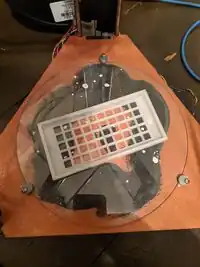
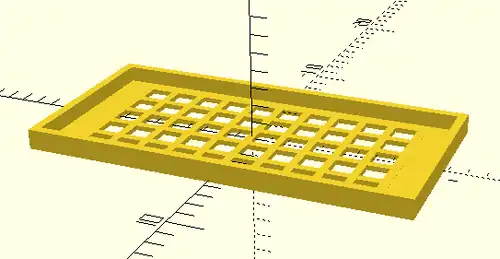
This project is an improvement made to this project created by User:btswanso. Densiometers are simple tools used by foresters all over the world to roughly estimate the amount of foliage coverage in a certain area of trees. This knowledge of coverage allows logging companies to make ethical decisions as to when forests need to be cut versus when they need to be left alone, which addresses the OSAT principle of transforming life on land. It is supposed to act as a stable grid that is placed over a photo taken with a generic smartphone (though it is designed for a Google Pixel 2XL). With 50 squares, finding a percentage of tree coverage is as simple as counting the "green" squares and multiplying the number by 2. After talking to a forester, I found that they like to have lightweight gear (so I worked for plastic reduction) that is still sturdy. Both these considerations were taken into account in the design process.
This design is better than the previous design in several ways. The previous design required a complex tripod to support it, which this design does not. As stated earlier, foresters enjoy carrying less equipment when possible. The old design also required the user to strain their neck to look at the densiometer from below. This design allows for more ergonomic viewing and counting.
Ability to slice 3D models for specific 3D printers
Technical Specifications and Assembly Instructions
This is a single-piece print that requires ~2.25 hours to print and ~34 grams of plastic at the recommended slicing settings
Recommended slicing settings include:
Material Type: PLA
Infill Density: 20%
Infill Type: Grid
Printing Temperature: 200 C
Heated Bed: No
Print Speed: 50 mm/s
There is no other necessary directions for print/assembly
Including drawings or pictures of the device at stage of assembly at minimum. (Upload)
Common Problems and Solutions
The most common problem is adhesion to the print bed, as the part is a large rectangle. To combat this problem, I recommend laying down a thin layer of glue (or other adhesive) to a glass print bed. This should help avoid adhesion issues.
While this solution requires that you own a smartphone, it could also be used up against a picture or in conjuncture with a mirror. The cost of the part alone is $1, which is a 99% cost savings.