Resources for community involvement
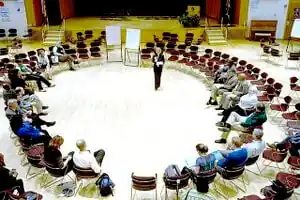
This article is an offshoot from Community involvement and is for global or international resources in that context. The majority of our information about this is collated via our place pages ...Near you.
Visions
- Radical Visions of Future Government, media.nesta.org.uk (date not found)
- CTRLShift 2019 on vimeo
Commons
- Paticipedia, A global community sharing knowledge and stories about public participation and democratic innovations.
Community resources

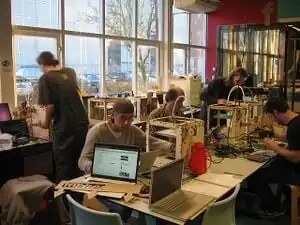
The aim of this page is to recognise, celebrate and encourage the self-empowerment of community agency networks (CANs) and community groups' activism for the recognition and growing of the full range of imaginable community resources... Why community resources matter
Conversation starters
- the Good Life Conversation, Cormac Russell, September 7, 2017 nurturedevelopment.org. "In simple terms the following questions help people to explore what contributions they might make to communities in which they reside."
How to's
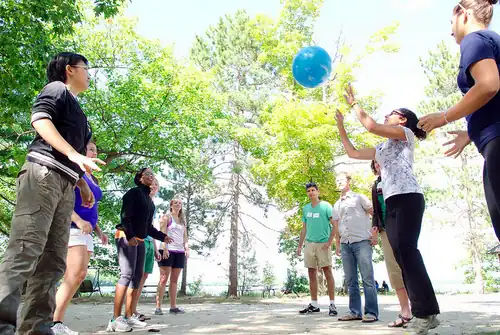
One of the hardest things (besides organising, running and maintaining!) a community group event is getting people to gel together at the beginning meeting(s). Using ice breakers to get people to know each other better is an important part of starting any community group where the members are from different areas and backgrounds.
more how to's:
- How to host: Stress-free communal eating, Wicked Leeks (May 15, 2023)
- Think, Do & Make: how to help people develop projects together by @noelito medium.com, Nov 5 2019
- ‘How to Set up a Municipalist Platform’, Barcelona en Comú, Mar 2016
- How to Start Participatory Budgeting in Your City, Dec 3, 2011, Shareable
Maps
Technology for transparency network
Quotes
"Turning toward local connection and action
It’s time to swim perpendicular to the tide, time to become a real citizen, and time to practice democracy like my life depends on it, because it does." Neal Gorenflo, January 31, 2020...shareable.net
"With the increasing awareness of movements like Extinction Rebellion and Fridays For Future, citizen activism is a social trend that's here to stay. There’s incredible technology at our fingertips and when used strategically, it has the potential to influence millions." Gabriella Tavini...thealternative.org.uk
There resides in all populations a "mass of sense lying in a dormant state - which good government should quietly harness." Tom Paine...Guardian review of Hilary Wainwright’s book Reclaim the State: Adventures in Popular Democracy, July 2003
*"Where I live in Marin County, it was citizen action that instigated the preservation of hundreds of thousands of acres as open space and parkland; it was not government taking the initiative. That mostly happened in the pre-Internet days. Now that we’ve got the Net and there’s more talent, creativity and freedom in the civic sector than in government, it’s time that citizens once again take the lead in building tools and solving problems for their localities." cfigallo...pResilience, April 7, 2009
"Given how radical a departure these participatory ways of working are from the closed-door status quo (or the view that participation is limited to voting and opinion polling), we cannot declare, define, and repeat often enough what it could mean to embrace collaboration and co-creation; to make consultation part of operations on a day-to-day basis; to strive for constant conversation with an engaged and knowledgeable public and to reinvent the conception of public service and of the public servant as the steward of such a conversation.." Beth Simone Noveck...Medium
Research
From what’s wrong to what’s strong: A guide to community-driven development, researchoutreach.org
Made to Measure, Participatory City, Year 1 Report for the EVERY ONE EVERY DAY initiative
Paticipedia, "an encyclopedia of participatory and deliberative practice"...The Alternative UK, Jan 27, 2019
Living labs

The concept of the living lab has been defined in multiple ways. A definition from the European Network of Living Labs (ENoLL) is used most widely, describing them as "user-centred open innovation ecosystems” that integrate research and innovation through co-creation in real-world environments.[1]
Emerging at the intersection of ambient intelligence research and user experience methodologies in the late 1990s, the concept was pioneered at the Massachusetts Institute of Technology (MIT) as a way to study human interaction with new technologies in natural settings. Over time, living labs have evolved beyond their origins as controlled research environments, becoming dynamic platforms for participatory design, collaborative experimentation, and iterative innovation across various domains, including urban development, healthcare, sustainability, and digital technology. Characterized by principles such as real-world experimentation, active user involvement, and multi-stakeholder collaboration, living labs enable the continuous adaptation and validation of solutions in everyday contexts. Today, they are implemented globally, supported by networks like the European Network of Living Labs (ENoLL), and increasingly recognized as vital tools for addressing local and global transformation agendas.
The European Network of Living Labs (ENoLL) is an international, non-profit, independent association of certified living labs, which popularized the living lab concept in the aim to increase user involvement in innovation. Formed in November 2006 under the guidance of the Finnish European Presidency, ENoLL is composed of a variety of stakeholders, including municipalities and research institutes, businesses, and users.[34] Its primary role is to support the collaboration among living labs across Europe and includes many living labs focused on user-driven innovation across sectors.
ENoLL focuses on facilitating knowledge exchange, joint actions and project partnerships among its historically labelled +/- 500 members, influencing EU policies, promoting living labs and enabling their implementation worldwide. ENoLL serves as a platform for linking living labs around the globe, which enables knowledge sharing and collaborative learning among diverse cultural environments.[34] Membership to the platform is open to organizations worldwide, and ENoLL has expanded beyond Europe to include global members. ENoLL follows an application and accreditation process, where aspiring living labs must demonstrate adherence to core principles of user-centered, open innovation and real-life experimentation. Successful applicants are officially recognized as accredited living labs and become part of the ENoLL network
Sharing ideas and actions
- Citizens Foundation, connecting government and citizens, added 14:20, 19 December 2020 (UTC), see also: Iceland
- Manifesto for Democracy and Sustainability
Software
Polis (or Pol.is) is wiki survey software designed for large group collaborations. As a civic technology, Polis allows people to share their opinions and ideas, and its algorithm is intended to elevate ideas that can facilitate better decision-making, especially when there are lots of participants.
Polis has been credited for assisting the passage of legislation in Taiwan. Pol.is has also been used in America, Canada, Singapore, Philippines, Finland, Spain and other governments around the world.
- Polis, "real-time system for gathering, analyzing and understanding what large groups of people think in their own words, enabled by advanced statistics and machine learning", added 10:41, 8 February 2022 (UTC)
- Ethical Alternatives & Resources from ethical.net, added 10:41, 8 February 2022 (UTC)
- Promise Tracker, Data collection for civic action. After an election, how can citizens hold elected leaders accountable for promises they made during the campaign season? We believe that informed communities, equipped with data, are the best positioned to assess the performance of their representatives and advocate for change on a local level. Promise Tracker explores how citizen monitoring can extend civic engagement between election cycles.
Other Resources
- People Powered, global hub for participatory democracy, Resources from peoplepowered.org, Video, peoplepowered.orgadded 10:41, 11 March 2022 (UTC)
- A Charter for Democracy on Commons Transition Strategies Wiki (creative commons license)
- Civic Activism
- Civic Commons Wiki, an effort to provide a permanent, sustainable organization to assist public agencies in the adoption of open systems and collaborative technologies, and to coordinate the co-creation of these technologies among agencies to ensure interoperability and shareability. Civic Commons will provide infrastructure, knowledge, and toolsets to government entities, and encourage the development of shared "civic software" and protocols, and supply optional technical infrastructure (such as data and project hosting) as needed.
- On Relational Facilitation: Supporting the Creative Potential of Divergent Perspectives, by R. Zubizarreta, dk-media.s3.amazonaws.com added 17:30, 17 February 2020 (UTC)
- Imagine Chicago, Imagine projects and networks in th UK, Europe and Australia have been modelled on Imagine Chicago.
- Open Government Partnership Participation & Co-creation Standards, added Feb 2017
- Benchmark study data The state of open data from different perspectives, including that of the public / citizens
- Introducing the Cycle of Transparency, Sunlight Foundation Blog, 03/10/10
- Resources from Imagine Chicago
- Making is Connecting - site about Making is Connecting project, with extracts, video, etc.
- Regulation on collaboration between citizens and and the City for the care and regeneration of urban commons, comune.bologna.it
- Who Ya Gonna Call? Deliberative Democracy Resources
- Wise Democracy Project
- World café, A world café (styled as World Café) is a structured conversational process for knowledge sharing in which groups of people discuss a topic at several tables, with individuals switching tables periodically and getting introduced to the previous discussion at their new table by a "table host".
- What is an Empathy Circle? empathycircle.com
local information and news can be found, or shared, via our many location pages
| Authors | Phil Green |
|---|---|
| License | CC-BY-SA-4.0 |
| Cite as | Phil Green (2021–2025). "Resources for community involvement". Appropedia. Retrieved November 28, 2025. |