Open spaces activism

The aim of this page is to recognise, celebrate and encourage the self-empowerment of community agency networks (CANs) and community groups' activism protecting, restoring and enhancing open spaces of all kinds from public places in urban environments to rural wilderness. Learn about how communities positively impact through innovations, different projects and collaborations.
News
 A Toxic Landfill Was on the Brink of Expanding. Residents Fought Back and Won, insideclimatenews.org (Aug 20, 2025)
 - A South Bronx Park is a Hive of Activity—for Bees and for New Yorkers Training for Green Jobs, insideclimatenews.org (Jul 23, 2025)
- Paris’s rewilded railway line: the disused track turned into a green space for wildlife and walkers, theguardian.com/ (Apr 03, 2025)
Community action projects
- Community orchards
- Open space conservation
- Reclaiming open space projects
- Angling and open space projects
- River and riverside projects
- Footpaths projects
- Ecosystem restoration
- Ecosytem restoration camps
- Rewilding
Events
 May 5 - 11, 2025 (Mon - Sun) — Screen-Free Week, can be celebrated at any time of the year! Though traditionally has taken place the first week of May
- May 08, 2025 (Thu) — Outdoor Classroom Day, celebrating and inspiring outdoor learning and play
- Jun 05, 2025 (Thu) — World Environment Day, June 5, annually
- Nov 06, 2025 (Thu) — Outdoor Classroom Day, celebrating and inspiring outdoor learning and play
- Dec 11, 2025 (Thu) — International Mountain Day, Dec 11, annually
Community orchards
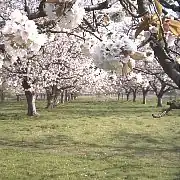
Community orchards offer a way of saving vulnerable old orchards and opportunities to plant new ones, providing places for quiet contemplation or local festivities, a reservoir of local varieties of fruit and a refuge for wild life. (see also Open spaces UK)
Open spaces and Sharing Cities
Open spaces are key to the health and vitality of cities. Walkable, safe, green spaces increase the possibilities for people to meet and nurture relationships beyond family, friends, and colleagues. But a discussion about Sharing Cities can't focus on open spaces alone. Gentrification should be a part of that discussion. If we, promoters of Sharing Cities, do not manage to address the tension of gentrification by finding strategies to secure the livelihoods of the people who produce the urban commons and to disarm profit-maximizing interests, then the tragedy of the urban commons will only be reinforced. The way the sharing economy discourse was co-opted by profit-oriented platforms shows how quickly Sharing Cities could fall over the barrier and become just another way to reproduce existing patterns of domination.
Social capital is shaped and molded by space. This same social capital is crucial in the successful self-organization of the commons, according to the late political economist Elinor Ostrom. Thus, in places where people can mobilize social capital, decades of urban planning practices are being challenged.
Digitalization is also an opportunity: It allows people to collect and make use of data in creative ways on an unprecedented scale. This has a huge potential for the urban commons. City administrators hold large amounts of land data that is so far hard to access or use, but when it becomes open data, it can unleash bottom-up innovations.
Last but not least, we should not forget that practices that foster Sharing Cities may have actually been there for decades. Some of those practices may be seen as old-fashioned, but might prove useful today. Adrien Labaeye[1]
See also Germany, South Africa
Quotes
"To sit in the shade on a fine day and look upon verdure is the most perfect refreshment." Jane Austen
See also: Health, Sustainable transport activism, Urban sustainability, Community land trust
local information and news can be found, or shared, via our many location pages
External links
- Project for Public Spaces, nonprofit organization based in New York dedicated to creating and sustaining public places that build communities. Planning and design rooted in the community form the cornerstone of PPS’s work. Building on the techniques of William H. Whyte's "Street Life Project," this approach involves looking at, listening to, and asking questions of the people in a community to discover their needs and aspirations.
References
| Authors | Phil Green |
|---|---|
| License | CC-BY-SA-3.0 |
| Cite as | Phil Green (2015–2025). "Open spaces activism". Appropedia. Retrieved November 28, 2025. |