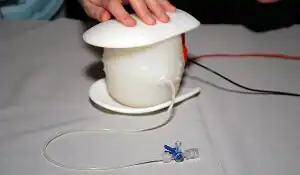
Mechanical Uterine Clamp
| Health topic | Maternal mortality |
|---|---|
| Health classification | Treatment |
| Type | |
|---|---|
| Authors | |
| Location | Virginia, United States |
| Status | |
| Years | |
| Made | No |
| Replicated | No |
Problem being addressed
Uterine atony, a loss of uterine muscle tone after cesarean birth, affects more than three million women each year. It can lead to potentially fatal postpartum hemorrhage, and treatment in low-resource clinical setting is often inadequate.
Detailed description of the solution
The Mechanical Uterine Clamp applies three different levels of compression to the uterus after a cesarean section. This device is simple to use and an inexpensive alternative to uterine massage.
Designed by
- Designed by: This device was designed by a team of five engineering students at the University of Virginia through a course offered by Timothy Allen, an Assistant Professor of Biomedical Engineering. These students are: Kimberly Everett, Vinu Ilakkuvan, Lara Wooten, Katie Youell and Kathryn Barbante. PDF available here.
- Manufacturer location: The University of Virginia, USA
Funding Source
This project received funds ($16,100) from the National Collegiate Inventors and Innovators Alliance in 2008. Link available here.
References
Other internally generated reports
University of Virginia School of Engineering and Applied Science. (2009, Spring). Reducing the risk of caesareans. Retrieved January 6, 2013. PDF available here.
Externally generated reports
National Collegiate Inventors and Innovators Alliance. (2008). Uterine atony device design team. Retrieved January 6, 2013. Link available here.
| Authors | Evashiu |
|---|---|
| License | CC-BY-SA-3.0 |
| Cite as | Evashiu (2013–2022). "Mechanical Uterine Clamp". Appropedia. Retrieved November 28, 2025. |