Jevons paradox
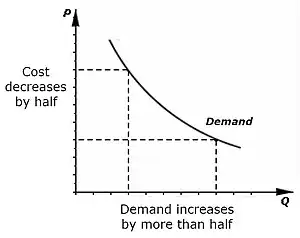
Jevons paradox refers to the increased use of a resource as a result of its efficiency. In other words, that reducing costs, alleviating difficulty, or increasing availability of a resource will result in more of it being used.
Definition

In economics, the Jevons paradox (; sometimes Jevons effect) occurs when technological advancements make a resource more efficient to use (thereby reducing the amount needed for a single application); however, as the cost of using the resource drops, if demand is highly price elastic, this results in overall demand increasing, causing total resource consumption to rise. Governments have typically expected efficiency gains to lower resource consumption, rather than anticipating possible increases due to the Jevons paradox.
In 1865, the English economist William Stanley Jevons observed that technological improvements that increased the efficiency of coal use led to the increased consumption of coal in a wide range of industries. He argued that, contrary to common intuition, technological progress could not be relied upon to reduce fuel consumption.
The issue has been re-examined by modern economists studying consumption rebound effects from improved energy efficiency. In addition to reducing the amount needed for a given use, improved efficiency also lowers the relative cost of using a resource, which increases the quantity demanded. This may counteract (to some extent) the reduction in use from improved efficiency. Additionally, improved efficiency increases real incomes and accelerates economic growth, further increasing the demand for resources. The Jevons paradox occurs when the effect from increased demand predominates, and the improved efficiency results in a faster rate of resource use.
Considerable debate exists about the size of the rebound in energy efficiency and the relevance of the Jevons paradox to energy conservation. Some dismiss the effect, while others worry that it may be self-defeating to pursue sustainability by increasing energy efficiency. Some environmental economists have proposed that efficiency gains be coupled with conservation policies that keep the cost of use the same (or higher) to avoid the Jevons paradox. Conservation policies that increase cost of use (such as cap and trade or green taxes) can be used to control the rebound effect.
Examples
- Fuel
- Digital technologies
| Authors | |
|---|---|
| License | CC-BY-SA-4.0 |
| Cite as | "Jevons paradox". Appropedia. 2022–2023. Retrieved November 28, 2025. |