JaipurKnee
| Health topic | Physical disabilities |
|---|---|
| Health classification | Treatment |
| Type | |
|---|---|
| Authors | |
| Location | India |
| Status | |
| Years | |
| Made | No |
| Replicated | No |
Problem being addressed
There are tens of thousands of amputees living in the developing world. Unfortunately, patients that live in these resource-poor areas and who lose a knee joint have few options. A titanium replacement can cost up to $10,000 and other inexpensive models are too crude to work effectively.
Detailed description of the solution
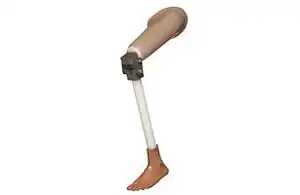
The JaipurKnee is flexible and stable, even on irregular terrain. It is comprised of five pieces of plastic, four nuts and bolts and has self-lubricating, oil-filled nylon. It does not require special tools and only takes a few hours to manufacture.
Designed by
- Designed by: Joel Sadler and team of classmates from a design course at Stanford University.
When and where it was tested/implemented
The device costs $20 USD and is more effective than other crude models. It works effectively on rough terrain. It is currently being tested in India with a projected 100,000 devices being distributed in the next three years.
References
Internally generated reports
Stober, D. (2009, April 15). Cool product: $20 artificial knee for patients in the developing world. Stanford News Service: (650) 721-6965. Link available here.
Externally generated reports
Abend L, Altman A, et al. The 50 Best Inventions of 2009. Time. Link available here.
| Authors | Evashiu |
|---|---|
| License | CC-BY-SA-3.0 |
| Cite as | Evashiu (2012–2022). "JaipurKnee". Appropedia. Retrieved November 28, 2025. |