Fecal Sample Collection Kit
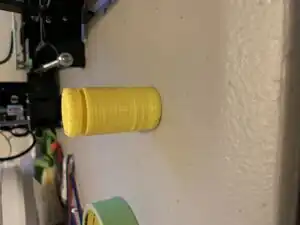
| Manufacturing files | https://www.youmagine.com/designs/fecal-sample-kit |
|---|---|
| Hardware license | CERN-OHL-S |
| Certifications | Start OSHWA certification |
| Type | |
|---|---|
| Authors | James Driesenga |
| Status | |
| Years | 2019 |
| Made | Yes |
| Cost | USD 0.24 |
This device is used to collect a small fecal sample for testing. This can range from DNA testing to testing for disease. Fecal matter can tell a lot about someones genetics and body function. This device is appropriate for OSAT because it can be used in developing countries and palces like Africa for testing for diseases. [Note to creator: Africa is a continent containing many countries with varying levels of development. Be careful when generalizing.] The device that has been developed is similar to the design shown below, but costing nearly 99% when compared. It was developed for Kijenzi/ HESE.
A similar design can be seen here.
Bill of Materials
- PLA or similar Printable material is all that is needed. PLA would be most appropriate due to its environmentally friendly nature
- All of my STL and SCAD files can be found at the following link: https://www.youmagine.com/designs/fecal-sample-kit
Tools needed
- MOST Delta RepRap or similar RepRap 3-D printer
Skills and knowledge needed
- There were no "special" skills or knowledge used to create this device. The only tool i used was the OpenScad cheat sheet for reference on some functions
Technical Specifications and Assembly Instructions
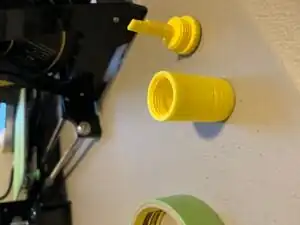
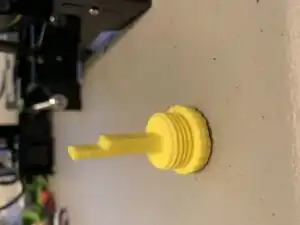
- To assemble this project, it is fairly simple. Once it is printed, it should just screw together with the printed threads. I did use 2 sets of pliers to get the threads to loosen up a bit do to the variance in my printer. To print this project, make sure to rotate the base.stl 180 degrees so that the bottom is on the build plate, as i designed it upside down.
- Print Time: 1.5 hours
- Assembly Time: 10 seconds
- The images shown show the 2 printed parts and what they look like when assembled.
Common Problems and Solutions
- The biggest issue is the threads being printed. In my design i was able to get it to work the first try, but they can still be improved. I was unable to get the threads to be "cut" from the material instead of being added like they are. If the threads had more of a cut feature to them where they were the same diameter as the inside of the cylinder this may solve the issue. To combat this issue, i printed the pieces fast to try and eliminate the effect of the overhangs.
Cost savings
- The cost to make this part is only $0.24 when using a $20 1 kg roll of PLA. It only uses 12 g of material.
- A commercial equvilent can be found here. It costs $131 [1]
for 500 so 26 cents each
Benefited Internet Communities
- Kinjezi/HESE @ Penn state [2]
- Concern Project [3]
- Bill and Linda Gates Foundation [4]
- The Red Cross [5]
- US Agency for International Development [6]
References
| Authors | James Driesenga |
|---|---|
| License | CC-BY-SA-3.0 |
| Organizations | MTU, Michigan_Tech's_Open_Sustainability_Technology_Lab, MY4777 |
| Cite as | James Driesenga (2019–2024). "Fecal Sample Collection Kit". Appropedia. Retrieved November 28, 2025. |