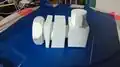
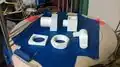
Spigots manufactured for self-attachment typically rely on large gaskets to maintain a seal, which works with varying success on the curved surface of a bucket. By modeling a bucket with just its top and bottom diameters and its average thickness, it's easy to design a spigot with contours that fit well. This design is expected to fit a wide range of bucket sizes effectively. The main attachment is reasonably easy to print, and typical modification requires changing only 4 parameters in two files.
Need to know top and bottom outer diameters of bucket, average thickness of bucket, and desired height of spigot - scripts will do the rest, assuming no other changes to geometry
Useful site for bucket dimensions: http://fivegallonideas.com/5-gallon-bucket-dimensions/[2]
Technical Specifications and Assembly Instructions
Like many interlocking parts, especially those with threads, this is sensitive to print quality - use 100% fill, a reasonable layer thickness, and printing speed
Expect total print times for the whole assembly between 3-5 hours - obviously dependent upon print parameters
Assembly time is negligible, expect drilling the bucket to take longer
Be sure to orient prints for slicing in a sane manner - flat ends down, etc.
Gallery
Parts & Assembly
Common Problems and Solutions
Previously mentioned sensitivity to print quality and likely need for a gasket
Stopcock is prone to ill fit, may be replaced with screw-based design in future
Cost savings
Typical mass-produced spigots for buckets retail for ~$2-5, though none seem to account for bucket contour and few are designed quite as heavy duty, and the cost of feedstock is furthermore quite low