Rwanda
| Map | |
|---|---|
| Location | Rwanda, Africa |
| Coordinates | 1° 57' 52.79" S, 30° 3' 51.97" E |
The aim of this page is to recognise, celebrate and encourage the self-empowerment of community agency networks (CANs) and community groups' activism for climate, environment and many other sustainability topics across Rwanda.
 Nimble Electric Trucks Are Supercharging African Trade, reasonstobecheerful.world (Dec 05, 2024)
 - Mountain gorillas: The ripple effect of conservation, BBC News (Jun 20, 2022)
- Rugby bringing African communities together, Feb 4, 2021...BBC News
Community energy
The use of off-grid solar power has increased as solar panel prices have fallen and many areas do not expect grid connections in the near future. Solar power produces over 2% of electricity in the country. The country is in the midst of a rapid expansion of its electrical grid and many new plants are proposed or under construction.
Biodiversity

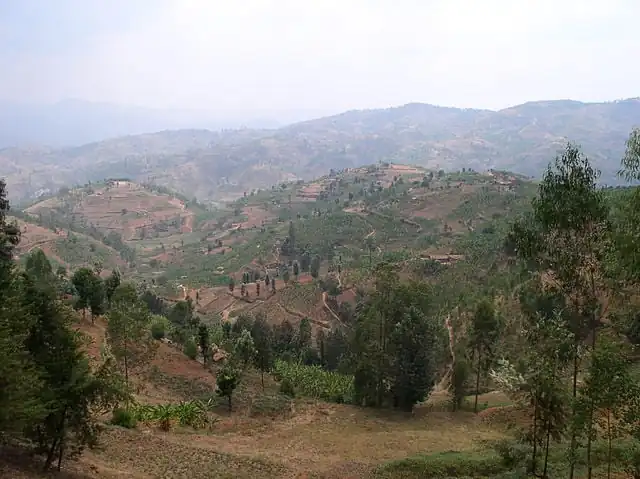
The wildlife of Rwanda comprising its flora and fauna, in prehistoric times, consisted of montane forest in one third the territory of present-day Rwanda. However, natural vegetation is now mostly restricted to the three national parks and four small forest reserves, with terraced agriculture dominating the rest of the country.
Ecoregions
Rwanda contains three terrestrial ecoregions: Albertine Rift montane forests, Victoria Basin forest-savanna mosaic, and Ruwenzori-Virunga montane moorlands. — From Wikipedia:Rwanda#Biodiversity
Trees, woodland and forest
The country had a 2019 Forest Landscape Integrity Index mean score of 3.85/10, ranking it 139th globally out of 172 countries. — From Wikipedia:Rwanda#Biodiversity
The national parks and forest reserves are under threat due to poaching, invasive plants such as water hyacinth, unauthorized livestock grazing, illegal fishing, bush fires, mining, bamboo harvesting, encroachment of protected land for agricultural farming, firewood gathering, be keeping and herbal plant extraction. This situation is attributed to governance issues lacking in legal acts and guidelines and also heavy anthropogenic pressure.
Conservation management plans have been instituted for all protected areas which involves the community of villages in and around the protected areas. Conservation activities have focused on increasing forest density by planting trees in a "natural self rehabilitation and natural regeneration of primary and high value species". The planting has involved Carissa macrocarpa, Entandrophragma (a genus of eleven species of deciduous trees) and Symphonia globulifera, and erecting protective fencing around forest reserves using leguminous thorny plants.
One of the efforts initiated by the government of Rwanda was to increase the number of protected areas and to proliferate tree plantations to increase the forest area cover of 10% to 20% by 2020.
News and comment
2010-2017
- Rural Rwanda is home to a pioneering new solar power idea, Oct 9, 2017...[1]
- Road safety initiative helps Rwanda's motorbike taxis stay on the right track, Clar Ni Chonghaile, December 28, 2015...[2]
- How Africa's fastest solar power project is lighting up Rwanda, November 23, 2015...[3]
- How Rwanda's clinics have gone off-grid and onto renewable energy, June 25, 2015...[4]
- 2010 SEED Award Winners,[5] November 3, 2010.
- "Production and Distribution of Pressurized Biogas in Gas Cylinders". This initiative has been developed by a private company, an international NGO and government organizations to produce and store pressurised biogas for cooking made from urban, domestic and industrial wastes. Environmental benefits are achieved by offering an alternative firing material to firewood and charcoal.
- "Efficient Charcoal Production and Smoke Recycling". This partnership of international NGOs, government institutions and a reforestation initiative is promoting new technologies to increase the energy output of charcoal. As a result, this significantly reduces the amount of forestland used for the production of charcoal and lessens air pollution by recycling tar and other smoke components.
- Rwanda named global host of World Environment Day 2010,[6] February 17, 2010.
References
Apps for sustainability
About Rwanda
Rwanda, officially the Republic of Rwanda, is a landlocked country in East Africa. Known as the "Land of a Thousand Hills" for its high elevation and rolling terrain, its geography is dominated by mountains in the west and savanna in the southeast. The largest and most notable lakes are mainly in the western and northern regions of the country, and several volcanoes that form part of the Virunga volcanic chain are primarily in the northwest. The climate is considered tropical highland, with two rainy seasons and two dry seasons each year. Its capital and largest city is Kigali, located at the centre of the country, at 1,567 metres above sea level.
| Authors | Phil Green |
|---|---|
| License | CC-BY-SA-3.0 |
| Cite as | Phil Green (2014–2025). "Community action/Rwanda". Appropedia. Retrieved November 28, 2025. |