Cuba
| Map | |
|---|---|
| Location | Cuba |
| Coordinates | 23° 0' 47.28" N, 80° 49' 58.35" W |
The aim of this page is to recognise, celebrate and encourage the self-empowerment of community agency networks (CANs) and community groups' activism for climate, environment and many other sustainability topics across Cuba.
News
 Climate disasters displaced 250 million people in past 10 years, UN report finds, theguardian.com (Nov 09, 2025) — Floods, storms and droughts have uprooted people across the globe as rising temperatures intensify conflict and hunger
- Alternative Editorial: Another World, Daily Alternative (Feb 09, 2025)
- Climate disasters displaced 250 million people in past 10 years, UN report finds, theguardian.com (Nov 09, 2025) — Floods, storms and droughts have uprooted people across the globe as rising temperatures intensify conflict and hunger
- The Guardian view on worsening extreme weather: the injustice of the climate crisis grows ever clearer, Editorial, theguardian.com (Nov 07, 2025)
- Seven Indigenous paths to protect the Amazon, news.mongabay.com (Sep 29, 2025)
- The Cambodian women rising up to protect their communal land, positive.news (Nov 20, 2025)
- Bees, Community, and Shared Futures, grassecon.substack.com (Nov 20, 2025)
- ‘Robot’ buses could bring more environmental benefits than public transport with drivers, theconversation.com (Nov 20, 2025)
Food activism

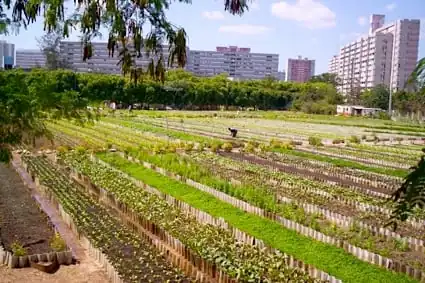
Cuba's agrarian revolution originated in the mountains of the Sierra Maestra when Law No. 3 of the Rebel Army was formally proclaimed in October of 1958. The principle of the law: Land should be given to those who tilled it; with the goal of massive land distribution.
The first Agrarian Reform Law was enacted on May 17, 1959. The second Agrarian Reform Law was enacted in October of 1963. These laws made the agricultural systems of Cuba socialist. Agricultural production cooperatives began in 1975, and were enacted August 24, 1982, as a superior form of collective production of social property started after the farmers' decision to join their lands and other means of production.[1]
The first agrarian reform created cooperatives and then consolidating agricultural production in state farms. The second created the agricultural production cooperatives (CPAs) and the third was the 1993 law creating UBPCs. These abbreviations come from the Spanish names.[2]
Video archive
- Cuba's DIY Inventions from 30 Years of Isolation on youtube
News archive
2009-2016
- Why So Many Havana Residents Grow Their Own Food, Jan 29, 2016...CityLab
- The farmer who's starting an organic revolution in Cuba, August 31, 2015...The Guardian
- Guardians of Cuba's urban green spaces, by Elaine Diaz...Global Voices Online, November 1, 2011.
- Sustainable Medicine, Cuba and Peak oil...off-grid.net, Oct 20, 2009.
About Cuba
According to a 2012 study, Cuba is the only country in the world to meet the conditions of sustainable development put forth by the WWF.

Cuba, officially the Republic of Cuba, is an island country in the Caribbean. It comprises 4,195 islands, islets and cays, including the eponymous main island and Isla de la Juventud. Situated at the confluence of the Caribbean Sea, Gulf of Mexico, and Atlantic Ocean, Cuba is located east of the Yucatán Peninsula, south of both Florida (the United States) and the Bahamas, west of Hispaniola (Haiti and the Dominican Republic), and north of Jamaica and the Cayman Islands. Havana is the largest city and capital. Cuba is the third-most populous country in the Caribbean after Haiti and the Dominican Republic, with about 10 million inhabitants. It is the largest country in the Caribbean by area. Culturally, Cuba is considered part of Latin America.
Cuba was inhabited as early as the fourth millennium BC, with the Guanahatabey and Taíno peoples present at the time of Spanish colonization in the 15th century. Cuba remained part of the Spanish Empire until the Spanish–American War of 1898, after which it was occupied by the United States and gained independence in 1902. A 1933 coup toppled the democratically elected government of Carlos Manuel de Céspedes y Quesada and began a long period of military influence, particularly by Fulgencio Batista. In 1940, Cuba implemented a new constitution, but mounting political unrest culminated in the 1952 Cuban coup d'état by Batista. His autocratic government was overthrown in January 1959 by the 26th of July Movement during the Cuban Revolution. That revolution established communist rule under the leadership of Fidel Castro. The country under Castro was a point of contention during the Cold War between the Soviet Union and the United States, and the Cuban Missile Crisis of 1962 is widely considered the closest the Cold War came to escalating into nuclear war.
References
| Authors | Phil Green |
|---|---|
| License | CC-BY-SA-3.0 |
| Cite as | Phil Green (2014–2025). "Community action/Cuba". Appropedia. Retrieved November 28, 2025. |