Bogotá
| Map | |
|---|---|
| Location | Bogotá, Colombia |
| Coordinates | 4° 39' 10.63" N, 74° 5' 0.83" W |
The aim of this page is to recognise, celebrate and encourage the self-empowerment of community agency networks (CANs) and community groups' activism for climate, environment and many other sustainability topics across Bogotá.
News
 ‘The tranquility frees you’: Bogotá, the city that shuts out cars every week, theguardian.com (May 30, 2024)
Networks and sustainability initiatives
- Neighbourhood initiatives across Bogotá
Open spaces

There are numerous parks in Bogotá, with facilities for concerts, plays, movies, storytellers, and other activities.
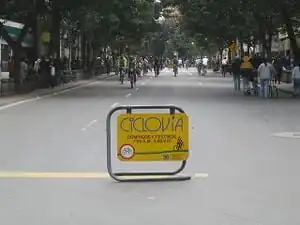
Cycling activism
Bike Paths Network
Bogotá is the city with the most extensive and comprehensive network of bike paths (Spanish: Ciclorrutas de Bogotá) in the Americas, with a total of 564 kilometers (350 mi) as of 2022. The network was initially designed and built during the administration of Superior Mayor of Bogotá Enrique Peñalosa and is one of the most extensive in the world.
The design of the network took into consideration the morphology and topography of the city. The network is integrated with the city's TransMilenio bus rapid transit system.
Ciclovía
see: Colombia, Cycling
Sustainable transport activism
TransMilenio
TransMilenio is a bus rapid transit (BRT) system that serves Bogotá, the capital of Colombia, and Soacha, a neighbouring city. The system opened to the public in December 2000. As of 2024, 12 corridors, which contains 120 bus routes totalling 114.4 km (71 mi) run throughout the city. It is part of the city's Integrated Public Transport System (Sistema Integrado de Transporte Público [SITP]), along with the urban, complimentary, and special bus services operating on neighbourhood and main streets.
TransMilenio consists of several interconnected BRT lines, with raised floor stations in the center of a main avenue, or "troncal". Passengers typically reach the stations via a bridge over the street. Usually four lanes down the center of the street are dedicated to bus traffic. The outer lanes allow express buses to bypass buses stopped at a station.
As of 2024, 1,801 buses on average were circulating on the trunk line system. An additional set of 869 regular buses, known as "feeders" (alimentadores in Spanish), carry passengers from certain important stations to many different locations that the main route does not reach. Unlike the main TransMilenio buses, feeders operate without dedicated lanes, are not articulated and are either green or blue (regular TransMilenio buses are red). There is no additional fare to use the feeder buses.
There are 27 bicycle parking facilities in main TransMilenio stations with 7,351 parking spaces to facilitate cyclists using the system. Eight BRT corridors were certified in 2013 to meet the BRT standard with excellence: Autonorte and Caracas silver, Americas, Calle 80, Eldorado, NQS, and Suba gold.
see also: TransMilenio, Controversies
Pico y placa
Pico y placa (literally Peak and Plate, Spanish for peak [hour] and [license] plate) is a driving restriction policy aimed to mitigate traffic congestion. The scheme was initially set in place in Bogotá, Colombia in 1998 by then mayor Enrique Peñalosa to help regulate traffic during rush hours. The system restricts traffic access into a pre-established urban area for vehicles with license plate numbers ending in certain digits on pre-established days and during certain hours. Initially, the system restricted traffic between 6 and 9 am and between 5 and 8 pm Monday through Friday.
The scheme restricts both private and public use vehicles based on the last digit of the licence plate numbers. Four numbers are restricted every day for private use vehicles, and two for public transportation vehicles. The restricted digits associated to each day rotate every year. Schemes with the same name have been implemented in other Colombian cities, such as Medellín and Cúcuta; and also in Quito, Ecuador's capital city.
News archive
2007-2020
- Bogotá expands bike lanes to curb coronavirus spread, Mar 20, 2020...smartcitiesworld.net
- Improving life in Bogota by empowering citizens to cycle, September 23, 2013...theguardian.com
- Bogotá: engineers improved upon the iconic bus rapid transit (BRT) system of Curitiba, Brazil, to create the TransMilenio, which has helped decrease air pollution, increase quality of life, and inspire similar projects in Europe, North America, and Asia...Worldwatch Institute, Cities Key to Tackling Poverty, Climate Change, January 10, 2007.
About Bogotá
Bogotá (, also UK: , US: , Spanish pronunciation: [boɣoˈta] ), officially Bogotá, Distrito Capital, abbreviated Bogotá, D.C., and formerly known as Santa Fe de Bogotá (Spanish: [ˌsanta ˈfe ðe βoɣoˈta]; lit. 'Holy Faith of Bogotá') during the Spanish Imperial period and between 1991 and 2000, is the capital and largest city of Colombia. The city is administered as the Capital District, as well as the capital of, though not politically part of, the surrounding department of Cundinamarca. Bogotá is a territorial entity of the first order, with the same administrative status as the departments of Colombia. It is the main political, economic, administrative, industrial, cultural, aeronautical, technological, scientific, medical and educational center of the country and northern South America.
| Authors | Phil Green |
|---|---|
| License | CC-BY-SA-3.0 |
| Cite as | Phil Green (2014–2025). "Community action/Bogotá". Appropedia. Retrieved November 28, 2025. |