Auckland
| Map | |
|---|---|
| Location | Auckland, New Zealand |
| Coordinates | 36° 51' 7.54" S, 174° 45' 47.45" E |
The aim of this page is to recognise, celebrate and encourage the self-empowerment of community agency networks (CANs) and community groups' activism for climate, environment and many other sustainability topics across Auckland.
Networks and sustainability initiatives
- The Kaipatiki Project
- Earthsong Eco-Neighbourhood, urban cohousing development in west Auckland, and a model of socially and environmentally sustainable urban living
- Mount Eden Village People
Food activism
Sustainable transport activism
wikipedia:Public transport in Auckland
Cycling activism
Tumeke Cycle Space, non-profit, community-run bicycle workshop in Auckland. It's a place where people can fix, build and learn about bikes in a safe and inclusive environment.
- Cycling popularity riding high on Auckland's pink pathway at Nelson St, Dec 15, 2015...stuff.co.nz
Ecosystem restoration

Kaipatiki Project is a grassroots, sustainability initiative based in Auckland, New Zealand. The organization promotes community involvement in preserving and restoring New Zealand's natural resources.
In 1998, the Kaipatiki Project was founded by a small group of Auckland residents who wanted to combat the effects of urbanization. These residents were concerned with the destruction of New Zealand's wild lands, and came together to restore native plants, clear weeds, and remove litter. As their efforts increased, Kaipatiki Project soon caught the attention of the local community. The organization soon secured funding for restoration projects, and volunteer numbers began to increase.
Open spaces
About Auckland

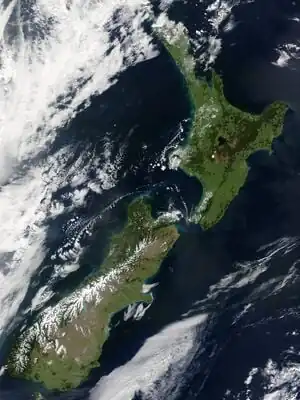
Auckland is a large metropolitan city in the North Island of New Zealand. It has an urban population of about 1,547,200 (June 2025). It is located in the greater Auckland Region, the area governed by Auckland Council, which includes outlying rural areas and the islands of the Hauraki Gulf, and which has a total population of 1,816,000 as of June 2025. It is the most populous city of New Zealand and the fifth-largest city in Oceania.
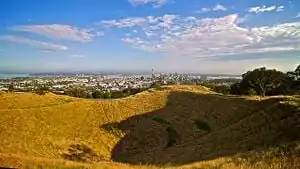
The city lies between the Hauraki Gulf to the east, the Hunua Ranges to the south-east, the Manukau Harbour to the south-west, and the Waitākere Ranges and smaller ranges to the west and north-west. The surrounding hills are covered in rainforest and the landscape is dotted with 53 volcanic centres that make up the Auckland Volcanic Field. The central part of the urban area occupies a narrow isthmus between the Manukau Harbour on the Tasman Sea and the Waitematā Harbour on the Pacific Ocean. Auckland is one of the few cities in the world to have a harbour on each of two separate major bodies of water.
Despite being one of the most expensive cities in the world, Auckland is recognised as one of the world's most liveable cities, ranking third in the 2019 Mercer Quality of Living Survey and at first place in a 2021 ranking of the global liveability index by The Economist.
| Authors | Phil Green |
|---|---|
| License | CC-BY-SA-3.0 |
| Cite as | Phil Green (2014–2025). "Community action/Auckland". Appropedia. Retrieved November 28, 2025. |