Adobe
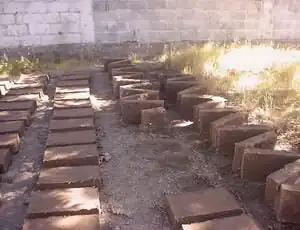

Adobe ( ə-DOH-bee; Spanish: [aˈðoβe]; via Spanish, from Arabic الطّوب (at-tūb)) is a building material made from loam and organic materials. Adobe is Spanish for mudbrick. In some English-speaking regions of Spanish heritage, such as the Southwestern United States, the term is used to refer to any kind of earthen construction, or various architectural styles like Pueblo Revival or Territorial Revival. Most adobe buildings are similar in appearance to cob and rammed earth buildings. Adobe is among the earliest building materials, and is used throughout the world.
Adobe architecture has been dated to before 5,100 BP.
Adobe is a type of earthen construction composed of Loam, usually fibers like straw and other organic materials. The adobe mixture is shaped into bricks using adoberas (wooden frames) and then dried in the sun. Adobe structures are extremely durable, with many very old structures still in use (e.g. kasbahs in morocco[1]). They also regulate temperature due to their high thermal mass, which is very useful in climates with high diurnal temperature swings.

Do not build multistage buildings only with adobe-bricks - they do not withstand earthquakes. see also: Earthquake proofing for buildings
Adobe (or loam) contains:
- Clay - under 0.002 µm
- Silt - 0.002 µm to 0.06 µm
- Sand - 2 µm
- Gravel - 100 µm
Improvements
It is common to add straw or other fiber-like materials to improve the strengthness of the Adobe.
List of components that were already used
Clay, Lime (around 5% maximum), Gipsum (around 5% maximum - use it only inside and in places without humidity), Faecal matter, Casein, Whey, Soap, Starch, Oils (such as Linseed oil. Apply it on dried adobe, not mix it in), Reisins, Waxes, Ash, Soda, Salt, Pigments, Sand, Gravel, Straw, Hemp, Hairs, Pinneadles, Coconut-fibers, Woodchips, Paper, Reed.
Hay is usualy not used because it tends to increase the chances of mold.
Things worth to mention
- All organic materials have to be mixed in in dry stage
- Every Earth is different - always make tests to see what works best
Adobe Bricks (How To Make Them)

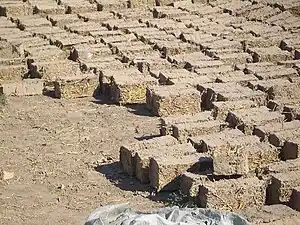
This page provides detailed instructions for making adobe bricks. It covers the equipment and materials required, as well as step-by-step instructions and frequently asked questions (FAQs). If you're interested in making your own adobe bricks, this page is a great place to start.
Other Building Methods
Dangers
Earthquakes are a big thread to adobe constructions. In 2003, a earthquake destroyed huge parts of the city of bam in iran, which was build mainly with adobe. According to wikipedia at least 34'000 people died and more than 200'000 were injured. therefore it is not recommended to build houses multistage houses with bricks. there are multiple ways to improve the structure and strengthness (such as geomesh) but the best way is to use a solid structure such as wood-frames and discuss it with professional bricklayers, carpenters or architects. between the structure, you can place the bricks.
Another danger is Radon which naturaly occurs in the earth. if the used adobe contains radon, it continuously evaporates and residents can get sicker and sicker. It is recommended to do a radon-test of the adobe, before start.[1]
Related projects
- Appropriate Technology Sourcebook/Adobe as a Socially Appropriate Technology for the Southwest (Solar-Adobe Sundwellings)
- Appropriate Technology Sourcebook/Part II
- Appropriate Technology Sourcebook/Forestry
- Alternative building
- Practical Action/Seismic retrofit
- Cobb
- DIF Adobe Senior Center
- Earthships
- Soil Preparation Equipment/Bibliography
- Greywater Ecuador La lagrima purificadora
- Parras earthen construction gallery
- Earthbag building
- GEN Solution Library
- Rancho Mastatal rocket stove
- Materials
- Permaculture wiki
- Earthen construction
- Practivistas Chiapas biodigester
- Peace Corps appropriate community technology/Construction of Earthen Blocks
- Construction techniques
- How to cool homes during a heat wave
- Ecological dry toilets at Pedregal
- Superadobe project
- Earthquake proofing for buildings
- Justa stove
- DIF Adobe Senior Center 2007
- Guía para productos de conocimiento y mapeo de soluciones/Procesamiento y almacenamiento
- Renewable energy dictionary/C-D
- Adobe Bricks (How To Make Them)
External links
- Wikipedia:Adobe
- Wikipedia:Loam
- wikiHow:Build an Adobe Wall
- networkearth - This site is loaded with the history, politics and techniques of many types of natural building.
- ABCs of making Adobe Bricks - Brief and could use some revision, but a good model of concise presentation.
- Earthquake resistant construction of Adobe Buildings: A Tutorial funded by the Earthquake Engineering Research Institute and hosted by the amazing world-housing database.
- Pequals.com Adobe Box Two girls, two adoberas (adobe forms), one big, adobe box. Renée and Kendra construct an adobe box in an attempt to hold water as an alternative to the plastic linings for ponds and gray water marshes.
- kleiwerks - Awesome natural-building teaching organization.
References
| Authors | Niels, Lonny Grafman, ATSysop |
|---|---|
| License | CC-BY-SA-3.0 |
| Cite as | Niels, Lonny Grafman, ATSysop (2006–2025). "Adobe". Appropedia. Retrieved November 28, 2025. |